Canadian school boards are increasingly under siege from cyberattacks, putting student data, school operations, and classroom learning at risk. In recent years, school districts across Canada – particularly in Ontario – have suffered data breaches compromising sensitive personal information and ransomware attacks disrupting day-to-day education. These incidents highlight that strong cybersecurity is now essential to keep schools safe and running.
A Growing Threat to Education
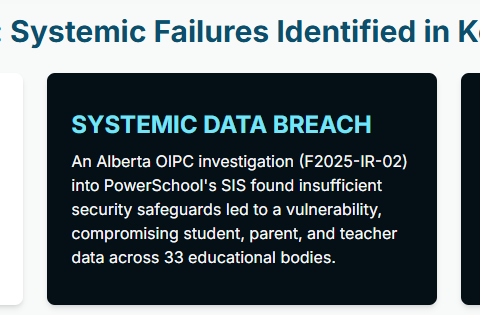
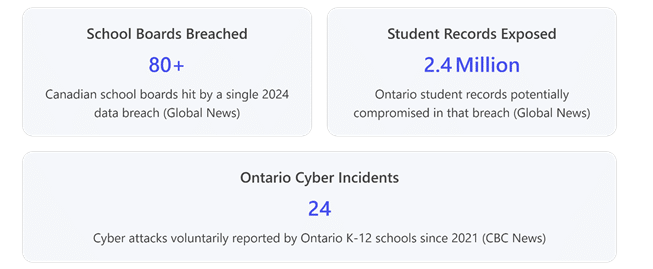
Cyber threats against schools are rising in scope and severity across Canada. Education has become a prime target for cybercriminals, much like healthcare and finance. In late 2024, for example, a breach of the PowerSchool platform – software used by many school boards – impacted over 80 school boards across seven provinces and one territory. Among those affected were 19 Ontario boards, including the Toronto District School Board (TDSB) and Peel District School Board, where more than 2.4 million student records were potentially compromised in one fell swoop [Global News]. This massive incident underscores how widespread and damaging cyberattacks on schools can be.
Cyberattacks on schools have become more frequent and sophisticated, experts say. Ontario’s Privacy Commissioner Patricia Kosseim notes that schools “hold vast amounts of personal information. They provide services that must continue…. They don’t have the choice of just closing down for a few weeks” [CBC News]. In other words, schools can’t simply halt operations to deal with a cyber incident – students need to be taught every day. Attackers exploit this urgency: they know that knocking out a school board’s IT systems can derail everything from attendance to lesson plans, pressuring officials to pay ransoms to restore critical services. As Kosseim emphasizes, schools are “vulnerable institutions that [cyberattackers] can really force into paying” if hit with a crippling attack [CBC News]. What used to be an IT department concern has become, as one cybersecurity expert put it, “a kitchen table conversation” for families and educators alike [CBC News].
Data Breaches Compromise Sensitive Information
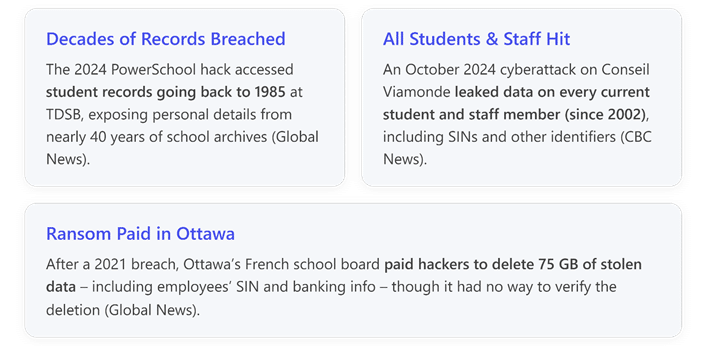
One of the most alarming impacts of school cyberattacks is the exposure of private student and staff data. Canadian schools maintain databases with years – even decades – of personal information, making them rich targets for data thieves. The late-2024 PowerSchool breach mentioned above is a prime example: student records dating back to 1985 were accessed at the TDSB during that incident, according to school officials [Global News]. For students who attended TDSB schools between 1985 and 2017, the compromised information included names, dates of birth, home addresses, phone numbers and health card numbers; for more recent students (2017–2024), even medical information and principal’s disciplinary notes may have been part of the breach [Global News]. And Toronto’s not alone – dozens of other boards in Ontario and across Canada had data stolen in that attack. It’s hard to overstate the seriousness: when hackers grab data on children and staff, the fallout can haunt victims for years. Identity thieves can combine bits of personal data to impersonate individuals, take out loans or commit fraud in their names even long after the breach. As tech analyst Carmi Levy cautioned, seemingly basic details from school files – an old address, a teacher’s name – can be leveraged by criminals to authenticate themselves and cause financial harm down the road [CBC News]. A child’s stolen personal data is essentially a blank slate identity that criminals covet.
Ontario has seen other major breaches exposing sensitive information. In October 2024, a hack of the Conseil scolaire Viamonde (a French-language public school board) not only knocked out the board’s phone and internet systems (more on that below), but also stole personal information of every current student and all staff employed since 2002 [CBC News]. For staff, highly sensitive data like social insurance numbers and even banking details were taken, while for students the breached files included names, birth dates, school records and student ID numbers [CBC News]. Similarly, back in 2021, Ontario’s Conseil des écoles publiques de l’Est de l’Ontario (CEPEO) – Ottawa’s French public school board – suffered a ransomware attack that exposed 75 GB of data, including employees’ SINs, bank account and credit card numbers, and other personal info dating back to 2000 [Global News]. In that case, the board made the difficult decision to pay the hackers a ransom in exchange for a promise that the stolen files would be deleted [Global News]. Unfortunately, there’s no guarantee criminals honor such promises – and indeed, in the 2024 PowerSchool incident, even after the company paid off the attackers, school boards began receiving new ransom demands using the stolen data a few months later [CBC News]. These breaches illustrate that losing control of personal data is perhaps the most devastating consequence of a cyberattack on a school. Beyond the immediate privacy violation, victims must deal with the potential for identity theft and financial fraud. School boards often have to offer credit monitoring to tens of thousands of people, and families are left anxious about where that information might surface. Protecting student and staff data is therefore paramount – it’s not just “security paperwork,” but a matter of safeguarding real individuals from harm.
Disrupting School Operations
Cyberattacks don’t only steal data; they can grind school operations to a halt, jeopardizing the basic functioning of education. Today’s schools depend on technology for nearly all daily tasks – taking attendance, contacting parents, accessing lesson materials, and more. When a ransomware or network attack strikes, those digital systems can go dark in an instant.
A stark example came in late 2024 at the Pembina Trails School Division in Winnipeg, Manitoba. In early December, a cyberattack struck Pembina Trails and “shut down basically everything we use: computers, P.A. systems, attendance online… anything that we’d use in a normal school in the modern age was pretty much wiped out,” said one Grade 10 student describing the impact [CBC News]. The entire school division’s network went offline, taking out phones, internet, printers – even school clocks were disconnected. For over two weeks, all 36 schools in the division had to revert to pen-and-paper operations, with “no internet whatsoever” in most buildings [CBC News]. Teachers lost access to email, digital gradebooks, and shared files, crippling their ability to deliver planned lessons. “Everything that you would normally use in the classroom has been kneecapped,” one teacher lamented, noting they couldn’t even photocopy materials with the network down [CBC News]. Staff scrambled to find workarounds like tethering laptops to cellphone hotspots. It took until after winter break for the division to slowly restore services, and even then things weren’t fully back to normal.
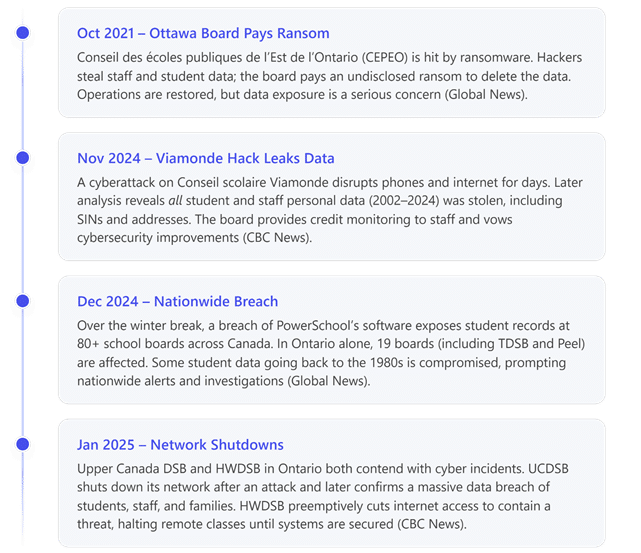
Ontario schools have faced similar havoc. In January 2025, the Upper Canada District School Board (UCDSB) in eastern Ontario abruptly shut down its entire IT network after detecting a cyber intrusion [Morrisburg Leader]. For days, UCDSB’s email, internet, and digital learning systems were unavailable as investigators assessed the damage. It soon emerged that the attackers had not only disrupted operations but also stolen personal information on over 50,000 current and former students (anyone who attended since 2010) and thousands of staff and parents – an enormous breach that took weeks to analyze [Morrisburg Leader]. In the meantime, the board had to delay report cards and could only gradually restore student accounts and Wi-Fi access.
Around the same time, in Hamilton, Ontario, the Hamilton-Wentworth District School Board (HWDSB) took the drastic step of turning off all school internet access on a Thursday evening after detecting unauthorized activity on its systems [CBC News]. By Friday morning, staff and students had no Wi-Fi or internal networks – a preemptive move to contain a possible attack. The disruption was significant even though schools remained open: all online services were paused, and in particular remote learning classes had to be immediately suspended because students at home could no longer connect [CBC News]. Routine processes like kindergarten registration and transmitting report cards were also impacted until systems were brought back online days later [CBC News]. Hamilton’s IT team, following a cybersecurity emergency plan, quickly involved police, government, and cybersecurity experts to resolve the incident [CBC News]. Thanks to such contingency planning, they avoided a total meltdown – but the event was a stark reminder that one intrusion can force an entire school board into crisis mode.
Even a short-lived outage can be chaotic. During the Viamonde board hack in 2024, schools in that board lost phone service and internal internet for several days [CBC News]. Teachers managed to keep classes running by using external networks (like mobile data), and the board later claimed that learning continued with “minimal” disruption [CBC News]. Still, it’s clear that every hour a teacher spends fighting technical issues or reverting to chalkboard methods is an hour lost from teaching. Modern education is deeply integrated with tech, so operational disruptions inevitably take a toll on instructional time and quality.
Impact on Students and Learning
When school systems go offline or data is stolen, students ultimately pay the price. These incidents have a direct, negative effect on students’ ability to learn and feel safe. The Pembina Trails story is illustrative: for over two weeks, students in that division had to cope with a tech blackout. Classes that relied on computers or internet activity were essentially put on hold – one high schooler noted that in some technology-oriented courses, “they’ve literally been watching movies because they can’t do anything” without computers [CBC News]. A Grade 10 student in Pembina Trails said “classroom learning has been set back” by the outage, as teachers struggled to adapt lessons to an analog format [CBC News]. The timing couldn’t have been worse: the attack hit just before mid-year exams and report cards, leaving everyone scrambling. Meanwhile, in Hamilton, the sudden shutdown of online learning in January 2025 meant that students enrolled in remote education simply had no classes for multiple days [CBC News]. Even though in-person schools stayed open, those remote students had to resort to self-directed materials until teachers could resume live instruction.
Beyond academics, these events cause stress and uncertainty. Students and parents may feel anxiety knowing that personal information (like health data or contact details) is in the hands of hackers. Older students, in particular, might worry about identity theft or find themselves distracted by the implications of the breach. Schools often send out formal breach notification letters which, while necessary, can be quite unsettling for families. There’s also the issue of safety during an IT outage: at Pembina Trails, the inability to use the public address system for a week raised real safety concerns. “What if there’s a lockdown? What if there’s an emergency and we need to know about it?” one teacher remarked, highlighting that a cyber incident could have compounded a crisis if one occurred [CBC News]. Fortunately, no such emergency happened during that outage, but it underscored a scary possibility: cybersecurity and physical safety are sometimes interconnected. If an attacker disables a school’s communications or alarm systems, it could hamper emergency responses.
In short, a compromised school network translates into lost learning time, delayed programs, and worried communities. Schools exist fundamentally to educate and protect children – when a cyberattack undermines those goals by shutting down teaching or exposing kids’ data, it strikes at the heart of the educational mission. This is why cybersecurity isn’t an “extra” for schools; it’s central to ensuring students can learn and thrive without unforeseen digital interruptions.
Why Attackers Target Schools
It may seem baffling that criminals would target schools, but in reality schools present an enticing combination of valuable data and urgent stakes:
-
Rich Data Troves: School systems store extensive personal information on students, families, and employees. This can include full identities, birth dates, addresses, health and academic records, Social Insurance Numbers, and more. Such data is extremely valuable for identity theft and fraud. A single school board breach can yield hundreds of thousands of personal records. Alarmingly, children’s data is especially prized by fraudsters because it often represents a “fresh” identity with no credit history – perfect for opening illicit accounts or loans undetected.
-
Pressure to Restore: Education is an essential service; schools can’t afford prolonged downtime. Attackers know that school boards are more likely to cave to ransom demands because the alternative – shutting schools or losing student records – is unthinkable. As one official noted, a school board does “not have the option of just closing down business for a few weeks” the way a company might [CBC News]. This urgent need to resume normal operations makes schools more likely to pay or negotiate, which in turn encourages criminals to target them.
-
Historically Weaker Defenses: Many school boards operate on tight budgets and have smaller IT teams, meaning cybersecurity may not have received the same investment as in the corporate world. Legacy software, limited security staff, and less stringent policies can make schools “soft targets.” Until recently, few school districts had dedicated cybersecurity specialists or robust training programs. This is beginning to change (often as a result of painful lessons learned), but attackers have been capitalizing on the relative vulnerability of educational institutions. For instance, prior to 2022 there was no province-wide cyber protocol in Ontario’s education system – each board was largely left to handle threats on its own, which meant inconsistent preparedness [Global News].
-
Abundance of Third-Party Software: Schools rely on many third-party applications (for learning management, student data, transportation, etc.). Each of these can be an entry point if not secured. The 2024 PowerSchool breach is a case in point: the attackers compromised a vendor’s system (PowerSchool’s tech support portal) and through it gained access to school board databases across multiple provinces [Global News]. Even boards with decent defenses were affected because the breach came through a trusted external provider. This interconnectedness means attackers can hit many schools at once via a single vulnerability.
These factors form a perfect storm. Schools have what cybercriminals want (data and leverage), and criminal tactics exploit what schools lack (uniform, well-resourced defenses). The result has been a surge of attacks on the education sector. A UK research firm reported that in 2022 and 2023, education was consistently among the top-targeted industries for ransomware worldwide, and Canadian incidents reflect that trend. Simply put, hackers go where the money and data are – and they’ve realized schools have both, plus a motivation to quietly pay them off.
Turning the Tide: Improving School Cybersecurity
The good news is that awareness is growing, and efforts are underway to bolster cybersecurity in Canada’s education sector. School boards, provincial ministries, and federal agencies have started taking action to protect our schools’ digital frontiers. Key initiatives include:
-
Provincial Cyber Strategies: Several provinces are actively developing cybersecurity standards for schools. In Ontario, the Ministry of Education released a draft Cyber Incident Response Standard in 2023 to provide boards with a playbook for handling incidents and reporting them https://www.blg.com/en/insights/2023/04/province-releases-cyber-incident-response-standard-for-ontario-school-boards]. While still being refined, this framework will eventually require every school board to have an incident response plan, defined roles, communications protocols (including how to notify the Ministry and privacy authorities), and regular drills. Ontario also worked with school boards to launch an annual Cyber Security Awareness Month specifically for K-12 in October, promoting training and best practices for staff and students alike. Other provinces, like British Columbia and Manitoba, have made it mandatory for school districts to report cyber incidents to authorities, improving visibility into the problem [CBC News]. (As of early 2025, only 5 jurisdictions in Canada mandate reporting of school cyber incidents resulting in privacy breaches – B.C., Manitoba and a few others – while the rest rely on voluntary disclosure [CBC News].) Experts, including Commissioner Kosseim, argue that mandatory reporting across the board would help coordinate responses and support affected schools better [CBC News].
-
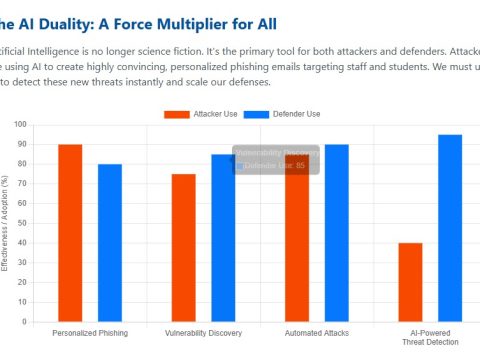
Better Defenses and Training: School boards are investing in stronger technical safeguards. This includes things like up-to-date firewalls, stricter network access controls, multi-factor authentication for staff logins, and aggressive backup routines so that data can be restored without paying ransoms. Importantly, many boards are also educating their employees and even students about cybersecurity hygiene. Since phishing emails remain a common entry point for attackers, boards have started running phishing simulation tests and regular awareness workshops for teachers and admins on how to spot scams and practice safe computing. In some cases, boards are hiring dedicated cybersecurity analysts or contracting external experts to monitor their networks. There’s also more collaboration on procurement: Ontario school boards, for example, are teaming up through the Educational Computing Network of Ontario (ECNO) to share cybersecurity services and threat intelligence, so smaller boards can leverage enterprise-grade tools. These preventative measures won’t stop every attack, but they raise the bar, making it harder for attackers to succeed and limiting the damage if they do get in.
-
Incident Response Planning: One clear lesson from recent attacks is that preparation matters. Boards that have an incident response plan and have practiced it can react faster and contain incidents more effectively. Hamilton’s quick decision to disconnect its network in January 2025, for instance, likely prevented a worse outcome – that kind of decisive action usually stems from advance planning. Now, many school boards are developing or updating cyber emergency plans: essentially the digital equivalent of a fire drill. These plans lay out exactly what to do if a breach or ransomware strike is suspected – who pulls the plug on servers, how to communicate with principals, how to switch to manual processes, and how to keep parents informed. Some boards have even conducted tabletop simulation exercises to rehearse their response. The faster a school district can respond (isolating infected computers, preserving backups, etc.), the less instructional time will be lost and the less data will be stolen. As the saying goes in cybersecurity, “attackers only have to be right once, but defenders have to be right every time.” Practiced incident response helps make sure when something does slip through, the defenders can minimize the harm.
-
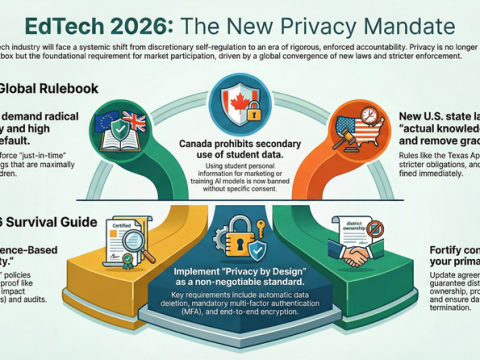
Protecting Data and Privacy Proactively: Schools are also rethinking what data they collect and how they store it. Since the more you collect, the more you must protect, some boards are following advice to limit the collection of student data to only what’s necessary and to purge old records when they’re no longer needed [CBC News]. Encryption of sensitive databases and strict user access controls are being employed so that even if hackers get in, they can’t easily access everything. The recent breaches have prompted boards to work closely with the federal and provincial privacy commissioners’ offices to audit their systems and patch weak spots. School boards are also leaning on software vendors to improve security – after the PowerSchool incident, affected districts (including ones in Alberta and Ontario) pushed the company to enhance its safeguards around maintenance accounts and are considering adding contractual requirements for security in future tech purchases [CBC News].
All these steps contribute to a culture change in education: treating cybersecurity as a fundamental part of running a school, not an optional add-on. This culture shift is still in progress, but momentum is building. The stakes became very clear after seeing students unable to learn because of a cyber incident, or millions of families’ data put at risk. As one Toronto parent said, “We have to be realistic that this is our future… You can’t stop it, but just be honest and transparent and do everything you can to prevent it” [CBC News].
Conclusion
From large urban districts in Ontario to small rural school boards in the Prairies, cybersecurity has proven to be essential for the education system in Canada. Recent incidents have shown that a single cyberattack can steal personal information on an entire generation of students, or shut down classroom learning for weeks. Protecting schools from these threats is about protecting our children’s futures – their privacy, their safety, and their right to an uninterrupted education.
Canadian schools are beginning to fight back by strengthening defenses, raising awareness, and planning for the worst. But continued focus is critical. This means sustained investment in up-to-date technology and IT staff, ongoing training for everyone in the school community, and supportive policies from government (such as clear incident reporting standards and resources for schools to draw on in an emergency). It’s often said that it’s not if a cyberattack will happen, but when. By recognizing that reality and preparing for it, schools can greatly reduce the impact when that “when” comes.
Cybersecurity matters for Canadian schools because our learners and educators depend on secure, reliable technology every day. A school cyber incident is not just an IT problem – it’s a threat to student well-being and an unacceptable interruption to education. By learning from the attacks that have occurred and proactively defending against new ones, Canadian schools can ensure that technology continues to empower learning, not disrupt it. In the digital age, cybersecurity is now as fundamental to a safe school environment as having locks on the doors and fire drills on the schedule. It’s part of the new homework for our education system – and doing that homework will keep our schools open, our data protected, and our students focused on learning.
Originally published on Chris’s Musing on Substack.