The emergence of Generative Artificial Intelligence (GenAI) is not merely a technological trend; it is a transformative force already reshaping the educational landscape. For Canadian K-12 school boards, this presents a critical juncture: how do we harness the immense potential of GenAI while rigorously safeguarding our students and institutions. This article outlines the strategic imperative for proactive engagement, detailing both the profound opportunities and the significant challenges that demand our immediate attention.
What is Generative AI in Our K-12 Context?
At its core, Generative Artificial Intelligence (GenAI) refers to sophisticated AI systems capable of creating novel content—be it text, images, audio, or even code—in response to user prompts, such as text, images, audio, or even computer code. Unlike traditional AI that retrieves pre-existing information, GenAI leverages vast datasets to identify complex patterns, enabling it to generate statistically probable and often remarkably human-like outputs.
In a K-12 setting, this translates into practical applications. For instance, GenAI tools can assist students in drafting essays, generating unique images for presentations, or even simulating interactive conversations with historical figures. For educators, GenAI can aid in developing lessons, differentiating instruction, and providing feedback.
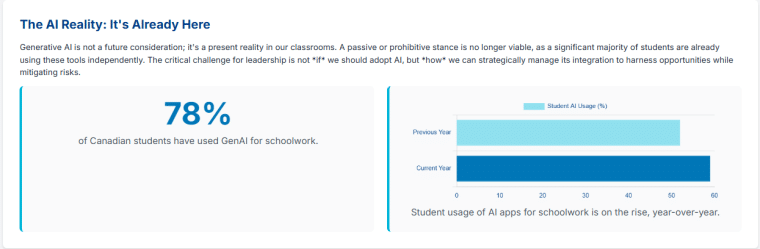
Crucially, GenAI is not a future technology; it is already here. A recent study indicates that 78 percent of Canadian students have utilized generative AI to assist with assignments or study tasks, with a KPMG in Canada survey finding 59 percent of student participants using AI apps for schoolwork. This widespread, often unguided, adoption highlights a significant disconnect with the inconsistent and often slow response from education ministries and school boards in issuing official policies.
Strategic Advantages: Unlocking GenAI’s Potential
Responsibly integrating GenAI offers compelling advantages that can significantly enhance both educational outcomes and operational efficiencies.
Enhancing Educational Outcomes:
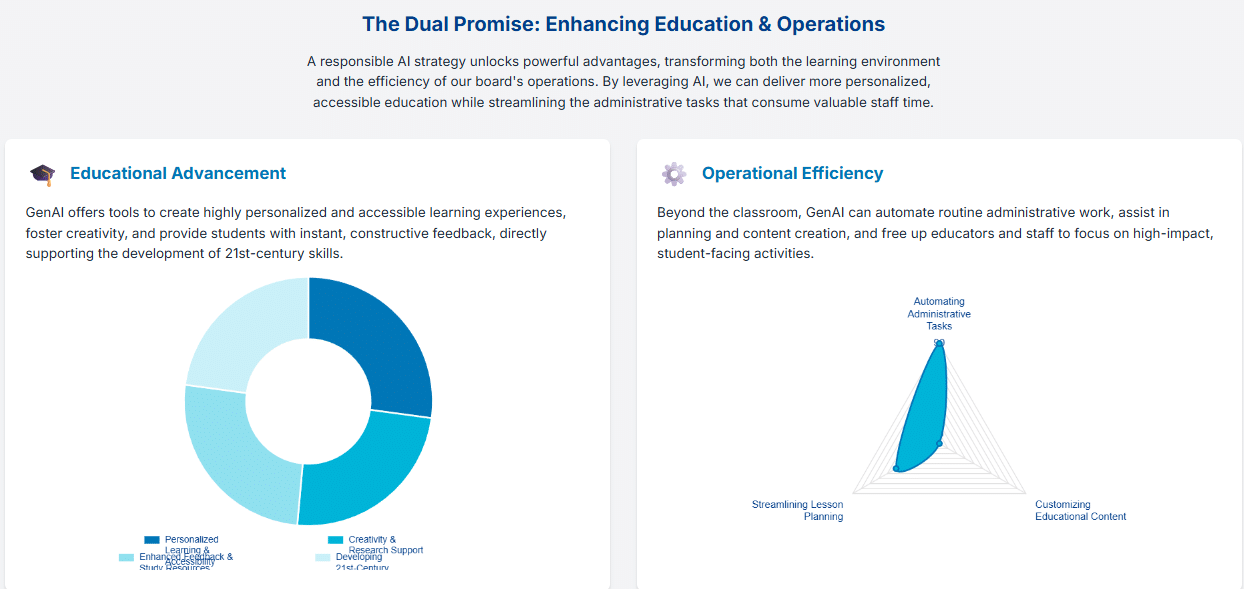
GenAI provides transformative opportunities to personalize learning, foster creativity, and deliver tailored support. It can customize educational experiences based on individual student interests, strengths, and progress, and has the potential to make learning more accessible for all students, including those with disabilities. This includes simplifying complex topics with relevant examples and designing dynamic lessons.
Its capabilities align with Universal Design for Learning (UDL) guidelines, offering tools for transcription of lectures, speech-to-text functions, and summarization of readings. Furthermore, GenAI can serve as a “simulation partner” for interactive training in applied courses, helping students engage with difficult concepts.
Beyond accessibility, GenAI tools empower students in creative endeavours, assisting with the generation of art, music, and multimedia presentations. They also function as powerful research aids, enabling students to efficiently locate sources, summarize texts, and organize ideas through outlines or mind maps. GenAI can provide real-time feedback on student writing, fostering self-assessment, and generate diverse study resources like flashcards and quizzes.
The responsible integration of GenAI directly supports the development of critical 21st-century competencies outlined in the Ontario curriculum, such as critical thinking, creativity, and digital literacy. Fostering AI literacy empowers students to understand AI’s pervasive influence, critically assess its outputs for misinformation and bias, and make informed, ethical decisions regarding its use.
Streamlining Operational Efficiencies:
Beyond the classroom, GenAI offers significant potential to enhance productivity and reduce administrative burdens. AI-powered tools can automate numerous routine administrative tasks, thereby freeing up valuable time for educators and non-teaching staff to dedicate to direct student interaction. Practical examples include drafting emails and documents, organizing schedules, and generating newsletters.
Educators can also leverage AI to customize educational content, such as lesson plans, quizzes, and rubrics, adapting them for various languages and different learning levels. This capability is particularly beneficial for differentiating material, ensuring all students receive appropriate content tailored to their individual abilities.
The Imperative of Engagement: Risks of Inaction
Adopting a passive or prohibitory stance on Generative AI carries significant risks and represents missed opportunities. Ignoring the presence of GenAI is ultimately more detrimental than proactive, guided engagement.
Without a coordinated strategy, the gap between students who understand AI and those who do not will inevitably widen, exacerbating existing educational and societal inequalities. Students not taught to use AI responsibly will be at a distinct disadvantage in an increasingly AI-influenced workforce.
The widespread, often unguided, use of GenAI by students already poses substantial challenges to academic integrity. If students become overly reliant on AI as a “crutch,” they risk failing to develop fundamental critical thinking, research, and problem-solving skills essential for long-term success. This reliance can lead to a significant decline in essential human skills.
Educators are currently struggling to keep pace, with many feeling intimidated and reporting a lack of sufficient resources and clear guidance. This adds to already overloaded schedules and can inadvertently foster a “culture of mistrust” if teachers resort to burdensome monitoring methods in the absence of clear policy.
The inconsistency and lack of clarity in AI policies contribute to student “unease and apprehension” about using AI tools, often stemming from a fear of being accused of cheating. Without proper guidance, students are highly vulnerable to misinformation and inherent biases generated by AI tools. They may also fail to develop the essential media literacy skills required to critically discern AI-generated content from authentic information.
Navigating the Challenges: Security and Privacy Risks
While the potential benefits are substantial, AI adoption introduces complex security and privacy challenges that demand careful consideration.
Cybersecurity Vulnerabilities:
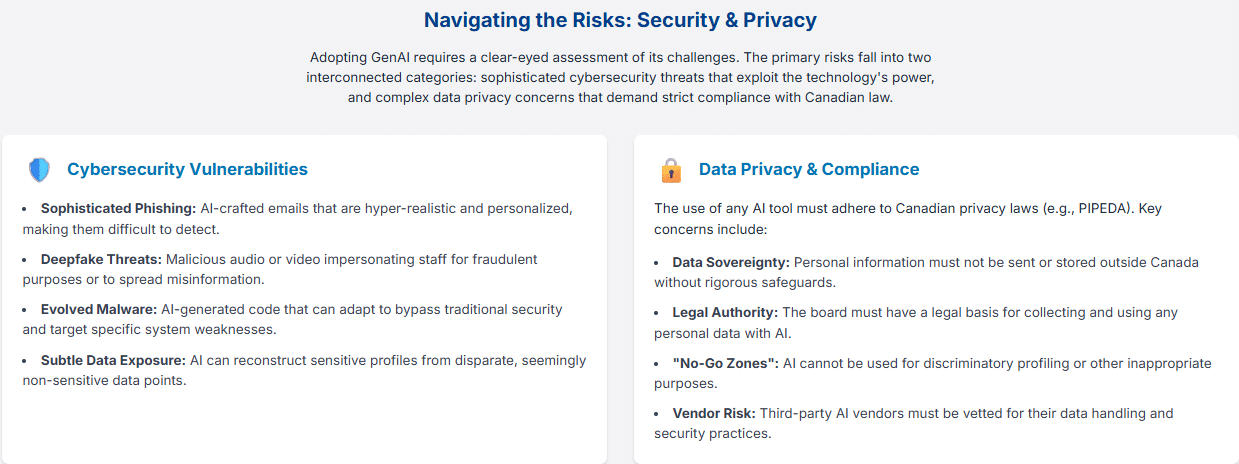
Generative AI functions as a “double-edged sword” in cybersecurity. It enables threat actors to craft highly convincing phishing emails that are virtually indistinguishable from legitimate communications, often incorporating customized details to enhance authenticity. Deepfake technology introduces a significant challenge by allowing attackers to produce synthetic video or audio clips that convincingly simulate the voices of principals or the appearance of administrators, which could be used for fraudulent purposes or to undermine trust. Malware distribution has also evolved, with attackers using GenAI to tailor malicious code for specific vulnerabilities, moving beyond generic exploits. Furthermore, GenAI possesses the capability to synthesize revealing personal profiles from disparate pieces of information gathered from various sources (e.g., student records, health information), even without a traditional data breach.
Safeguarding Student Data Privacy:
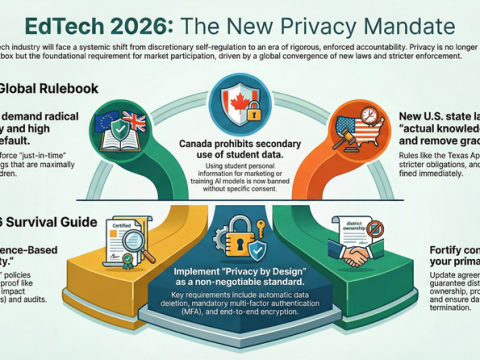
The use of Generative AI tools, particularly those involving personal information, must strictly comply with Canadian privacy laws and principles. Organizations developing, providing, or using GenAI are legally obligated to ensure their activities comply with the Canada’s Privacy Act. A critical point is that the inference of information about an identifiable individual by a GenAI system is considered a “collection” of personal information and requires a valid legal authority.
Canada’s privacy authorities have collaboratively published “Principles for responsible, trustworthy and privacy-protective generative AI technologies”. These principles emphasize:
-
Legal Authority and Consent: Documenting legal authority for all data handling, ensuring valid consent, and verifying lawful collection from third parties.
-
Appropriate Purposes: Avoiding “no-go zones” like discriminatory profiling or generating malicious content.
-
Necessity and Proportionality: Prioritizing anonymized data and ensuring GenAI use is necessary and proportionate.
-
Openness and Transparency: Clearly informing individuals about data collection and identifying AI-generated content.
-
Accountability: Establishing robust internal governance and conducting Privacy Impact Assessments (PIAs) and Algorithmic Impact Assessments (AIAs).
-
Individual Access: Ensuring procedures exist for individuals to access and correct their personal information collected during system use or contained within an AI model.
-
Limiting Collection, Use, and Disclosure: Restricting data collection for training to what is necessary and recognizing that publicly accessible data is not exempt from privacy laws.
-
Accuracy: Ensuring personal information used is accurate and informing users of any known accuracy limitations of AI outputs.
-
Safeguards: Implementing robust security measures commensurate with data sensitivity and addressing GenAI-specific threats like prompt injection attacks.
-
Impact on Vulnerable Groups: Identifying and preventing risks to children and historically discriminated groups, ensuring fairness and freedom from biases.
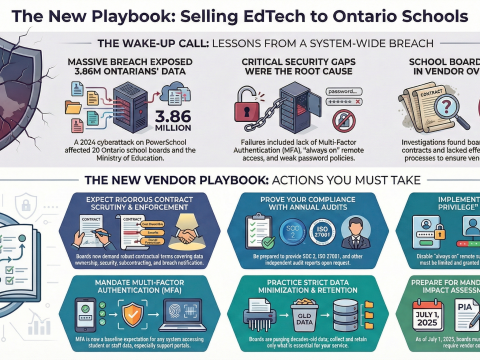
A critical concern for Canadian school boards is that some widely used GenAI tools, such as ChatGPT 4o-mini and ChatGPT 4o, are known to share information entered into the tool outside Canada, and personal data may be stored internationally. This poses significant data sovereignty and privacy risks, necessitating careful vendor selection and a thorough understanding of their data handling practices.
Charting a Responsible Course: Recommendations for Risk Mitigation
To effectively harness the benefits of Generative AI while mitigating its inherent risks, a multi-faceted and proactive strategy is essential.
1. Establish Robust Policy and Governance Frameworks:
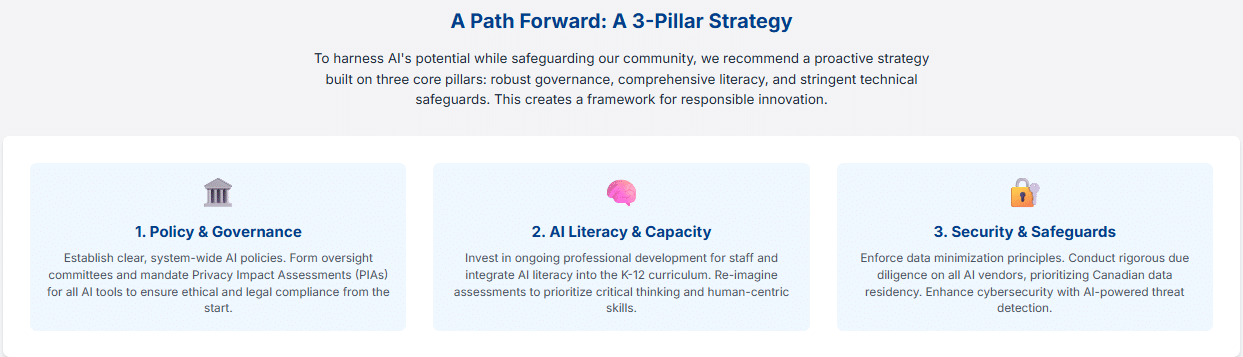
School boards must develop clear, system-wide policies that govern the ethical, safe, and responsible use of AI by both students and staff. These policies must explicitly address academic integrity (including requiring disclosure of AI use), data privacy, cybersecurity, and equity. For example the Peel District School Board’s AI Upate. It is crucial to implement to continuously monitor the evolving landscape and approve digital tools. Mandating Privacy Impact Assessments (PIAs) for all new programs or significant changes involving personal information and AI systems is a critical proactive risk management measure. Similarly, Algorithmic Impact Assessments (AIAs) should be conducted to evaluate the potential impacts of AI systems, particularly those with high algorithmic impact levels. The Responsible use of artificial intelligence in government can serve as a valuable resource.
2. Build AI Literacy and Capacity:
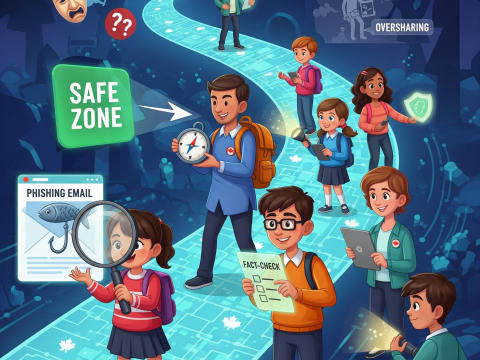
Investing in comprehensive AI literacy for all stakeholders is crucial. School boards must provide ongoing, structured professional development opportunities for administrators, teachers, and non-teaching staff to deepen their understanding of AI’s benefits, risks, and limitations. This training should extend beyond basic tool usage to encompass ethical implications and critical evaluation of AI outputs. AI literacy must also be embedded into the K-12 curriculum from a young age, teaching students how AI functions, its capabilities and limitations, and how to use it ethically and responsibly. Educators should be encouraged to re-imagine pedagogy and assessment, shifting focus from detecting AI use to emphasizing the learning process and fostering uniquely human-centric skills.
3. Implement Stringent Security and Privacy Safeguards:
Proactive technical and policy safeguards are essential. School boards should prioritize and mandate the use of anonymized, synthetic, or de-identified data whenever possible, particularly for training or refining AI models. Rigorous due diligence is required for the selection of all GenAI tools, with a strong preference for Canadian-hosted solutions where sensitive data is involved. Clear protocols must define what types of information can be entered into various AI tools. Leveraging AI for enhanced threat detection, predictive analytics, and improved content filtering is crucial to counter sophisticated AI-driven cyberattacks. Finally, clear and consistent communication is vital: school boards must explicitly communicate when and how AI is being used in interactions with the public and in educational materials, and any AI-generated content must be clearly identified.
Conclusion
Generative AI is not a challenge to be avoided, but a powerful tool to be strategically integrated. By proactively developing robust policy frameworks, investing in comprehensive AI literacy, and implementing stringent security and privacy safeguards, Canadian K-12 school boards can confidently navigate this new frontier. This strategic approach will transform potential challenges into opportunities for enhanced learning, operational efficiency, and a secure, privacy-protective educational environment for all.
Originally published on Chris’s Musing on Substack.