Executive Summary
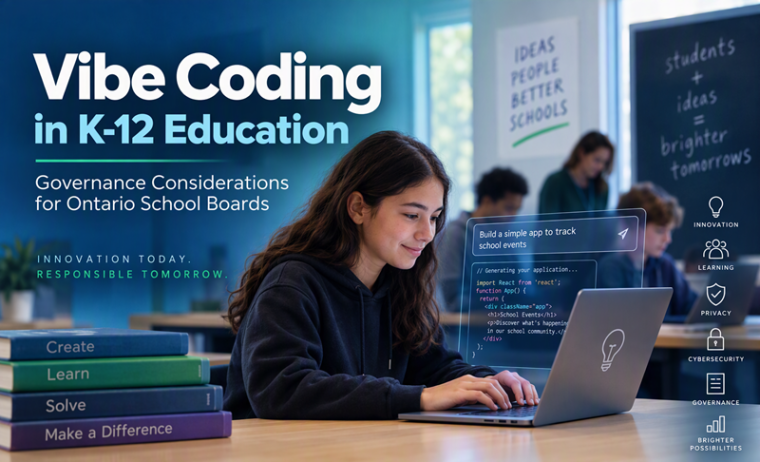
Artificial intelligence is changing how software is created. Through a practice commonly called vibe coding, students and educators can describe an application in natural language and have AI generate much of the underlying code.
The educational potential is significant. Students can create websites, applications, automations and digital tools with little or no traditional programming experience. This lowers barriers to innovation, entrepreneurship and digital problem-solving.
At the same time, software can now be created and deployed faster than many existing governance processes were designed to manage.
For school boards, the challenge is not whether students should be allowed to experiment with AI-generated software.
The challenge is ensuring that innovation occurs within an appropriate framework of privacy, cybersecurity, accountability and risk management.
Why This Matters
Historically, boards generally evaluated software before it entered classrooms.
Vibe coding changes that model.
Applications can now be created quickly by students or staff using combinations of:
-
AI coding assistants
-
Cloud hosting services
-
External databases
-
Third-party APIs
-
AI models and analytics services
Some projects will remain classroom demonstrations. Others may evolve into tools that collect information, interact with board systems, or become operational services.
The distinction matters.
A prototype built using synthetic data presents fundamentally different risks from an application that collects student information or relies on external service providers.
The Legal and Regulatory Environment
MFIPPA
The Municipal Freedom of Information and Protection of Privacy Act (MFIPPA) remains the primary privacy framework governing school boards.
Boards remain accountable for personal information in their custody or under their control, even when that information is processed by third-party vendors, cloud providers or software platforms. The use of an AI tool or external service does not transfer accountability.
For board leaders, key questions include:
-
Is the collection of personal information necessary?
-
Is there legal authority for its collection, use or disclosure?
-
Is information being shared with external service providers?
-
Are adequate safeguards in place?
-
Are retention and disposal requirements understood?
The legal analysis supporting Ontario school board use of digital systems consistently emphasizes data minimization, transparency, secure handling and documented oversight.
EDSTA and Digital Tool Transparency
Effective July 1, 2026, Ontario Regulation 52/26 under the Enhancing Digital Security and Trust Act (EDSTA) introduced new obligations relating to third-party software applications used by school boards.
Where a student’s personal digital information is shared with a third-party software application, boards must provide notice identifying:
-
The information being shared
-
The legal authority for the disclosure
-
The purpose of the disclosure
-
The software application
-
The third-party owner or operator
-
Contact information for questions and concerns
This obligation is proactive and increases expectations for visibility into the digital tools being used within educational environments.
Upcoming MFIPPA Changes
Amendments coming into force on January 1, 2027, introduce mandatory privacy impact assessment and privacy breach reporting requirements for municipal institutions, including school boards.
These changes signal a continued shift toward documented privacy governance and demonstrable due diligence.
Key Risks
Vibe coding introduces several governance risks that boards should understand.
Privacy Risk
Applications may collect more information than is necessary or send information to external providers without adequate review.
Cybersecurity Risk
AI-generated code may contain vulnerabilities, insecure configurations or weak access controls.
Third-Party Risk
Applications frequently rely on multiple vendors and service providers, creating complex information-sharing arrangements that may not be immediately visible.
AI Risk
Generated applications may produce inaccurate, biased or unreliable outputs, particularly when used to support decisions affecting students.
Sustainability Risk
Applications created by an individual student or educator can become operational tools without defined ownership, support or lifecycle management.
A Governance Response
School boards do not need to choose between innovation and accountability.
A balanced approach can support both.
Encourage Low-Risk Innovation
Provide approved environments where students can build and experiment using synthetic or non-identifiable data.
Establish Review Thresholds
Additional review should occur before an application:
-
Collects personal information
-
Connects to board systems
-
Uses external AI services
-
Creates user accounts
-
Is shared beyond the classroom
-
Becomes an operational service
Maintain Visibility
Boards should understand which applications, AI services and third-party providers are being used and what information is being shared.
Use Risk-Based Assessment
Not every classroom project requires the same level of review.
Governance processes should distinguish between:
-
Classroom experimentation
-
Controlled educational use
-
Operational deployment
The level of oversight should increase with the level of risk.
Questions for Senior Leadership
Boards should be able to answer the following questions:
-
Where can students and staff safely experiment with AI-generated applications?
-
What information may and may not be used in prototypes?
-
When does a classroom project require additional review?
-
How are third-party providers identified and assessed?
-
How are privacy and cybersecurity obligations being met?
-
Who becomes accountable when a project moves into operational use?
-
How will applications be maintained, monitored and retired?
Bottom Line
Vibe coding represents a significant educational opportunity. Students can create software, solve problems and develop digital skills in ways that were not previously possible.
The opportunity, however, comes with governance responsibilities.
As software creation becomes increasingly accessible, boards must ensure that privacy, cybersecurity and accountability evolve at the same pace.
The objective is not to slow innovation.
The objective is to create an environment where innovation can occur safely, responsibly and with appropriate oversight.
Transparency Statement: AI tools were used as a research and drafting aid in the preparation of this document. The ideas, analysis, perspectives, and recommendations are my own. All substantive content, editorial decisions, revisions, and final approval were completed by the author.
Originally published on Chris’s Musing on Substack.