It didn’t arrive with a purchase order or an implementation plan. Like the smartphone before it, Generative Artificial Intelligence (GenAI) is an “arrival” technology. It’s already in our classrooms, on our students’ phones, and in our teachers’ web browsers. The conversation in education has rapidly shifted from if we should permit AI to how we can possibly harness it safely and ethically.
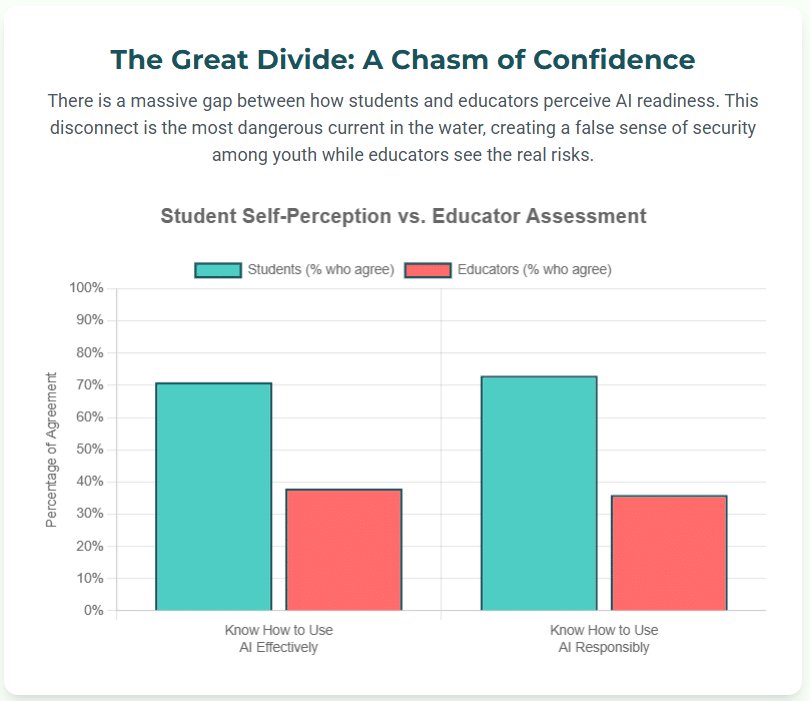
Across Canada, the response has been a “mishmash” of inconsistent policies, leaving educators feeling unsupported and exposed. Teachers are grappling with this new reality largely on their own, asking fundamental questions like, “If I integrate AI, am I actually the teacher who is pedagogically in charge?” This policy vacuum is untenable. For school board leaders, a failure to act is a decision to accept unmanaged risk. The only path forward is to lead with a clear, principled strategy.
More Than Just a Smart Spell-Check
To build a strategy, we first need a shared understanding. For years, schools have used forms of artificial intelligence—systems capable of performing tasks normally associated with human cognition, like learning and problem-solving. This includes reactive AI (like a simple game that gives a fixed response) and predictive AI, which uses past data to forecast future outcomes (like a search engine or a platform that flags at-risk students).
But Generative AI is different. It doesn’t just analyze or predict; it creates new, original content—text, images, code, and music—in response to a prompt. It’s helpful to think of GenAI as a “powerful calculator”. It can perform incredible feats of information processing, but it’s useless without a human who knows which questions to ask and how to critically interpret the results. This new creative capability is what presents both unprecedented opportunities and profound challenges.
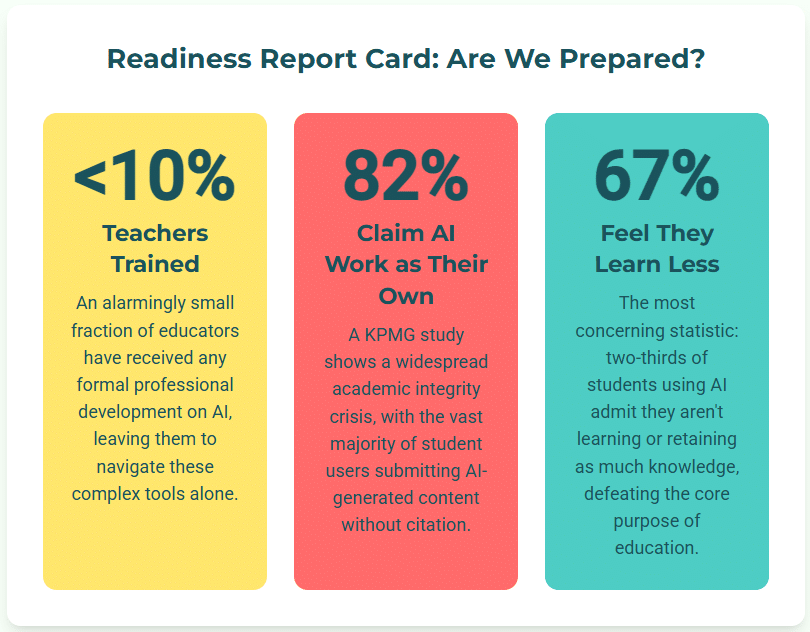
The Dual Landscape: Opportunity and Peril
The potential benefits of GenAI are transformative, touching every aspect of a school board’s operations.
For educators, one of the most compelling applications is the potential to significantly reduce workload and burnout. At one innovative Calgary School, custom-built AI tools named Ally and Harmony help teachers draft lesson plans and report card comments in minutes, saving them days or even weeks of administrative work.
For students, AI promises a new era of personalized and differentiated instruction. The Abbotsford School District, for example, champions tools like Diffit, which can take a grade-level text and instantly re-level it for different reading abilities or translate it for English Language Learners. This allows every student to access the core curriculum in a meaningful way. Similarly, the Ottawa Catholic School Board highlights tools that tailor activities to a student’s specific interests and academic abilities.
However, these opportunities are shadowed by significant risks that strike at the heart of our educational mandate.
-
Privacy and Security: This is a non-negotiable. When a student or teacher inputs information into a public, unvetted AI tool, that data can be stored on servers outside of Canada, used to train commercial models, and exposed in breaches. This creates a high risk of violating Canadian privacy laws like the provincial Freedom of Information and Protection of Privacy Act (FIPPA) and the federal (https://cloud.google.com/security/compliance/pipeda-canada). The rise of unapproved “Shadow AI” applications creates a massive, uncontrolled security threat, making schools vulnerable to the sophisticated, AI-powered phishing attacks the Canadian Centre for Cyber Security warns about.
-
Ethics and Bias: AI systems learn from the data they are trained on. If that data reflects societal biases, the AI will learn and amplify them, a phenomenon sometimes called “automating inequality.” This directly threatens a school board’s commitment to equity. Proactive districts like the Peel District School Board are already building guidance that requires educators to evaluate tools for bias and ensure they don’t reinforce stereotypes.
-
Copyright: The legal landscape surrounding AI and copyright in Canada is unsettled and risky. Most large AI models were trained on vast amounts of internet data, almost certainly including copyrighted works without permission or compensation to the creators. Furthermore, it’s unclear under Canadian law whether content generated by an AI can even be copyrighted, potentially placing board-created materials in the public domain.
Charting a Course: From Reaction to Responsible Action
Navigating this complex terrain requires a fundamental shift in our approach to teaching and assessment. The first instinct—to find software that can “detect” AI writing—is a dead end. These tools are notoriously unreliable and raise their own privacy issues.
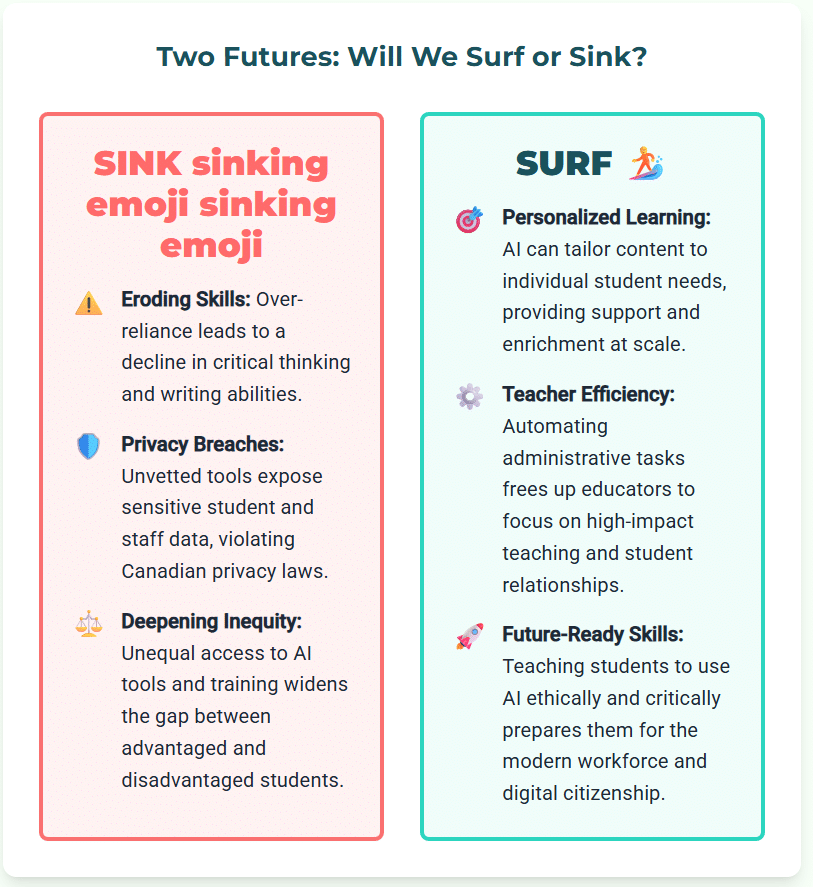
The real solution is to design “AI-resilient” assessments that measure deeper learning. This means moving away from tasks that are easily automated and toward evaluations that make student thinking visible. This can include:
-
A return to monitored, in-person assessments like handwritten essays and oral presentations.
-
Focusing on the learning process, not just the final product. Students can be asked to submit their AI prompts and a reflection on how the tool helped or hindered their thinking.
-
Designing authentic, context-specific tasks that require students to connect concepts to recent classroom discussions or their own personal experiences.
Beyond resisting misuse, we must also teach responsible use. The University of Alberta’s Centre for Teaching and Learning provides an excellent framework for intentionally and transparently integrating AI into assignments—from using it for brainstorming to using it as a full collaborator.
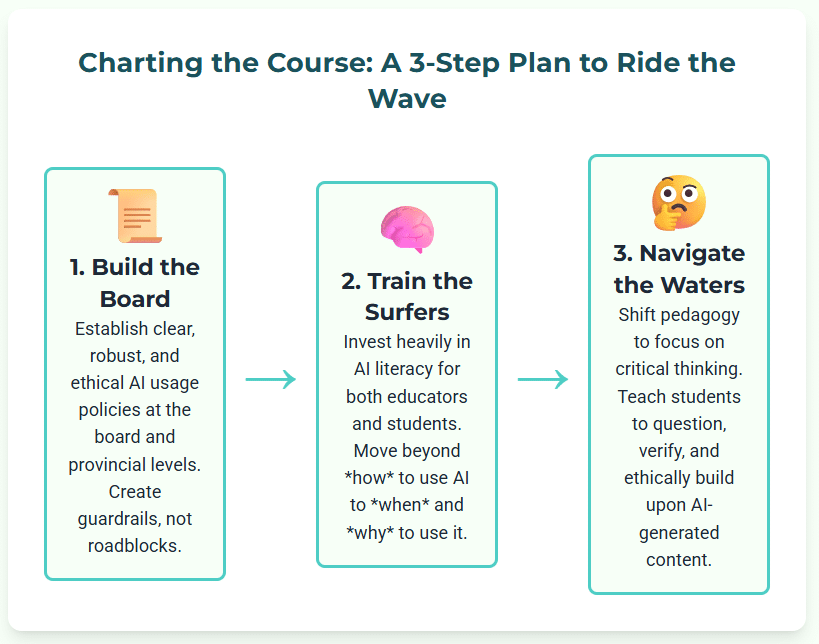
This pedagogical evolution cannot happen without clear guardrails and robust support. The guiding principle must be that AI is a tool to augment, not replace, the professional judgment of our educators. Education is fundamentally relational, and we must preserve the human-centric nature of learning. This requires:
-
Clear, Board-Level Guidelines: Districts like the Upper Canada District School Board have published principles that define responsible use, promote transparency, and clarify expectations around academic integrity.
-
Mandatory, Ongoing Professional Development: Teachers need more than a one-off workshop. They need sustained training on the ethical, safe, and effective use of AI, a call echoed by the Canadian Teachers’ Federation.
-
A Culture of Critical Thinking: The most important skill in the AI era is the ability to critically evaluate information. We must teach students to question AI outputs, check facts against trusted sources, and understand the limitations and biases of these powerful new tools.
The AI tsunami has already reached our shores. School boards that try to build a wall against it will find themselves swamped. Those that learn to surf—by leading with principle, investing in their people, and redesigning their practices—will be the ones who successfully navigate this new world. The time for leadership is now.
Originally published on Chris’s Musing on Substack.