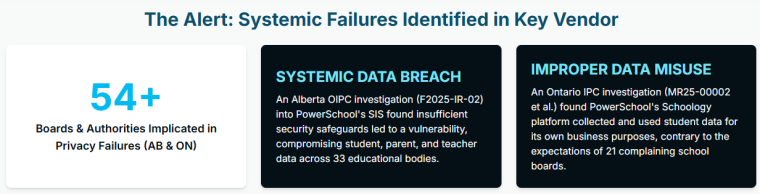
For years, Canadian school board leadership has operated under a comforting assumption: if we hire a major, global technology vendor with all the right certifications (ISO, SOC 2), we have discharged our duty of care regarding cybersecurity. We assume the risk has been transferred.
The coordinated investigations into the December 2024 PowerSchool data breach by Privacy Commissioners in Ontario, Alberta, Saskatchewan, and Canada have violently dismantled that assumption.
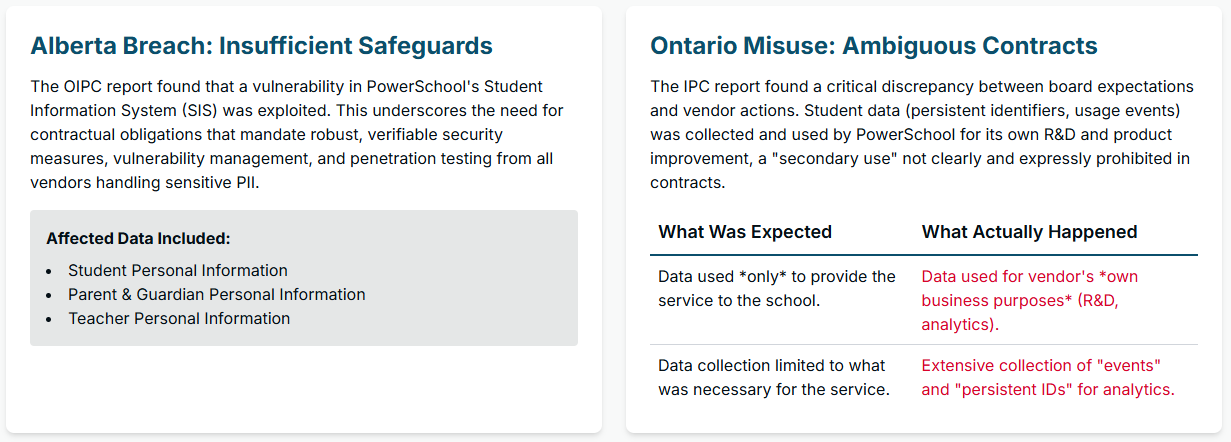
The breach, which exposed the personal information of approximately 5.2 million students, staff, and parents across Canada, was not merely a story of a stolen password. It was a story of systemic governance failure. The findings released by the commissioners reveal that school boards relied on a “paper shield” of contracts and certifications that they rarely read and almost never enforced.
For Superintendents, Trustees, and CIOs, the message is brutal but necessary: You cannot outsource your liability.
The Myth of the “Certified” Vendor
One of the most jarring findings from the Alberta Office of the Information and Privacy Commissioner (OIPC) was the deception regarding audit scope. School boards took comfort in PowerSchool’s SOC 2 and ISO 27001 certifications. These are the gold standards of security compliance.
However, the investigation revealed a critical gap: the specific portal that was compromised—PowerSource, the community support portal used by technicians—was excluded from the scope of these security audits.
Boards assumed that because the vendor was “certified,” their data was safe. They failed to verify if the specific door guarding their data was actually part of that certification. This is a failure of Vendor Risk Management (VRM). Leadership accepted a badge of compliance without checking what was actually being policing. The lesson? If you don’t read the audit report’s scope section, the audit report is worthless.
The “Employee” Reality Check
Perhaps the most significant legal finding came from Alberta. The Commissioner ruled that under the Freedom of Information and Protection of Privacy Act (FOIP), a service provider like PowerSchool is legally defined as an “employee” of the school board.
This is a paradigm shift for risk management. Boards often view vendors as third parties—external entities that can be sued if things go wrong. But legally, the breach occurred inside the house. The board is vicariously liable for the vendor’s security lapses because the vendor is acting as an agent of the board.
This means that when PowerSchool failed to implement Multi-Factor Authentication (MFA) on its support portal—a basic security standard—that failure belonged to the school boards. You cannot contract away your statutory accountability.
The “Toxic Tail” of Data Hoarding
If the governance failures were bad, the internal data practices exposed by the investigations were worse. The investigations revealed a massive “toxic tail” of historical data that amplified the damage of the breach.
The Information and Privacy Commissioner of Ontario found that one board had student data dating back to 1965 sitting in its live production environment. In Saskatchewan, the Commissioner slammed the Prairie Spirit School Division for the “over-collection” of Social Insurance Numbers (SINs) and Health Services Numbers—data points that are generally unnecessary for educational administration but are gold mines for identity thieves.
Why are school boards holding onto the grade 3 report cards of people who are now grandparents? Why are they collecting the SINs of 6-year-olds?
This is a failure of Data Minimization. By treating data storage as infinite and free, boards turned their student information systems into massive liabilities. Every record kept beyond its statutory retention period is a lawsuit waiting to happen. The breach would have been a minor incident if boards had purged old data; instead, it became a generational privacy disaster because no one hit “delete.”
The “Always On” Open Door
The technical vector of the attack also highlighted a failure of oversight. The investigations found that many boards had their remote maintenance access set to “Always On”.
PowerSchool support staff could connect to the boards’ databases at any time. This convenience feature created a persistent bridge between the vendor and the school board. When the threat actor compromised the vendor’s support portal, that bridge became a highway into the schools’ data.
The Alberta Commissioner noted that this configuration violated the principle of “least privilege.” Remote access should be “on-demand”—enabled only when maintenance is happening and cut off immediately after. Leaving the door unlocked because you might order a pizza later is bad security; leaving a database port open permanently for occasional maintenance is negligence.
A Roadmap for Leadership
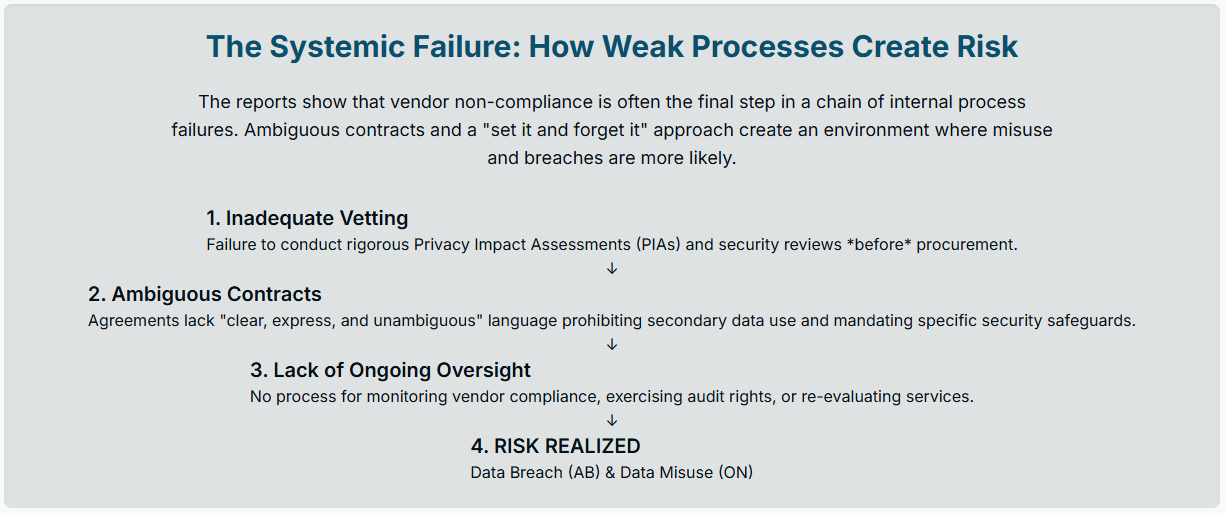
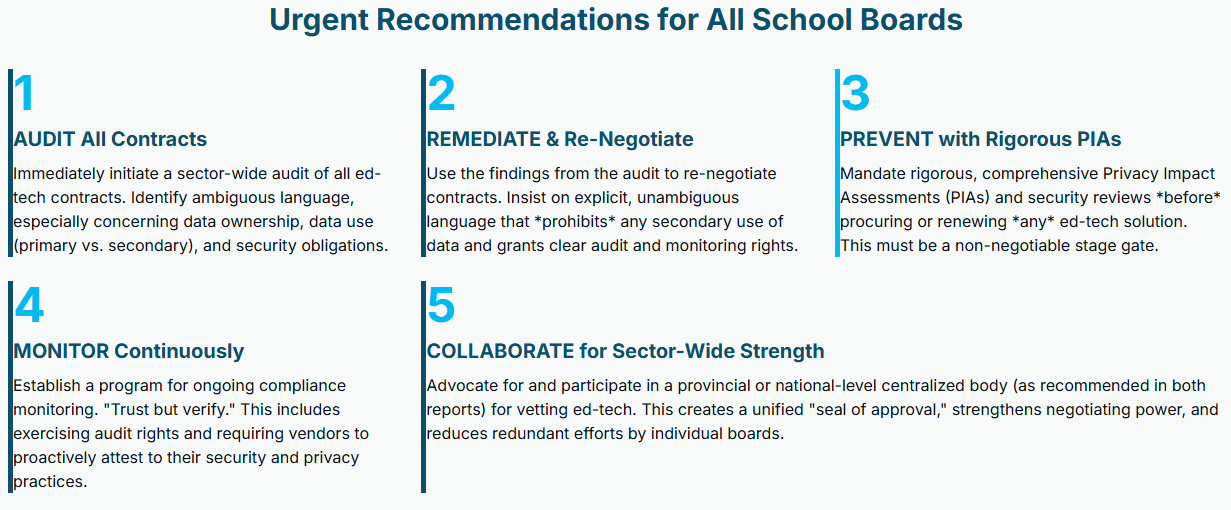
The Commissioners have issued their orders, but for leadership, this must be treated as a strategic pivot point. The status quo is no longer tenable. Here is what School Board leadership must do immediately:
1. Audit Your Audits: Stop accepting summary certificates. Demand the full SOC 2 or ISO audit reports from your vendors. Look specifically at the “Scope” section. If a vendor supports your data using a tool that isn’t in the audit scope, that is a critical risk that must be mitigated or accepted formally by the Board.
2. Purge the Toxic Tail: Launch an immediate data minimization project. If you are holding student data from the 1980s in a live, internet-facing system, you are negligent. Automate the deletion of records that have passed their statutory retention period. If you don’t need a SIN to teach a child math, delete the SIN.
3. Renegotiate Contracts: The Ontario investigation found contracts dating back to 2011.1 These legacy agreements are useless against modern ransomware threats. New contracts must include:
-
Mandatory MFA for all vendor staff accessing your data.
-
Explicit rights to audit the vendor.
-
Strict breach notification timelines (e.g., 24 hours, not the 10 days it took PowerSchool to notify boards).
4. Treat Vendors as Staff: If the law views them as employees, you must vet them like employees. You wouldn’t hire an IT admin without a background check; don’t hire a SaaS provider without a security architecture review.
Conclusion
The PowerSchool breach was a painful lesson, but it offers clarity. The days of passive vendor consumption are over. School boards are the custodians of our children’s digital lives. We cannot hand the keys to a vendor and look the other way. It is time to govern our digital supply chains with the same rigor we apply to our physical schools.
References:
Originally published on Chris’s Musing on Substack.