
Google Cloud Security’s Cybersecurity Forecast 2026 paints a stark picture of the future. It’s a landscape where artificial intelligence is the attacker’s primary weapon, where cybercrime has evolved into multifaceted extortion, and where digital supply chains are the main battleground. It’s tempting to file this away as a “problem for 2026.”
But for Canada’s K-12 education sector, this isn’t a forecast. It’s a diagnosis of the crisis happening right now.
The 2024-2025 school year was catastrophic, marked by a wave of devastating cyberattacks. The breach of PowerSchool, an educational technology (EdTech) provider used by boards across the country , compromised the data of millions of students and staff. This, combined with crippling, separate attacks on major school boards , has exposed a systemic vulnerability.
Google’s report doesn’t just predict the future; it provides a framework for understanding the attacks of today. Here’s what the 2026 forecast means for Canadian schools, right now.
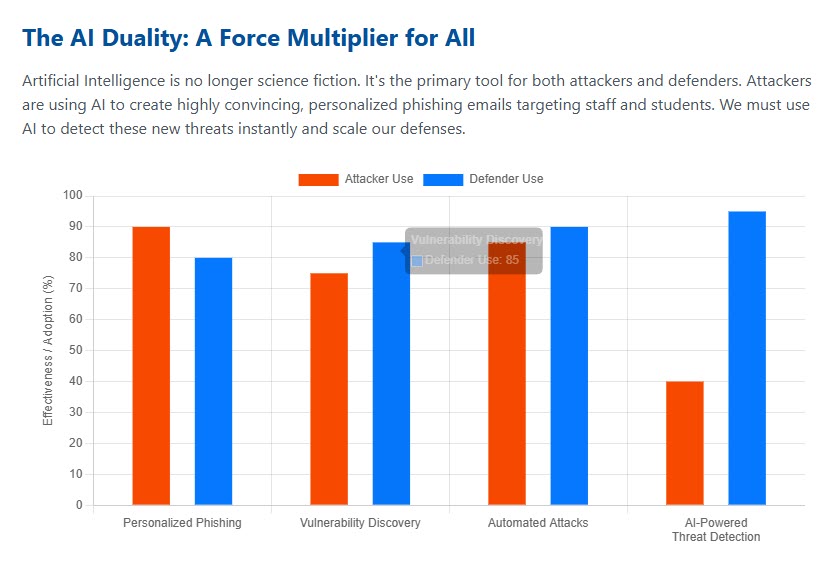
1. AI-Driven Attacks: The Weaponization of Trust
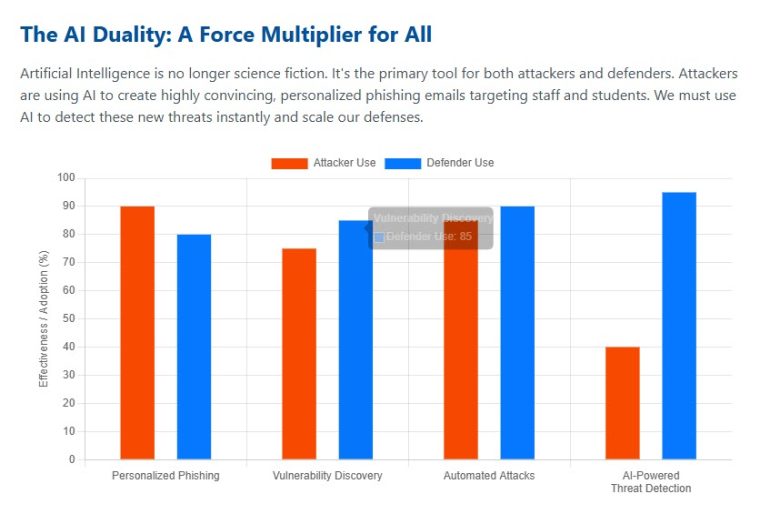
The 2026 Forecast: Google predicts attackers will “fully embrace AI” to accelerate “highly manipulative AI-enabled social engineering”. This moves beyond just realistic phishing emails. The report highlights the threat of “vishing” (voice phishing) using AI-driven voice cloning to create “hyperrealistic impersonations” of executives or IT staff. The goal is to exploit “human weaknesses” to bypass technical defenses.
The K-12 Reality: This threat is uniquely dangerous to the high-trust, high-speed environment of a school. An AI-cloned voice of a principal authorizing an emergency student pickup, or a superintendent demanding an “urgent” wire transfer from a school’s finance administrator, is no longer science fiction. Attackers understand that school staff are conditioned to act quickly and with trust. By impersonating these nodes of trust, AI-driven attacks can dismantle security from the inside.
2. The “Shadow Agent”: When Good Intentions Create Massive Risk
The 2026 Forecast: The report warns of a “Shadow Agent” challenge, an evolution of “Shadow AI.” This is where employees, seeking efficiency, “independently deploy powerful, autonomous agents for work tasks, regardless of corporate approval.” This creates “invisible, uncontrolled pipelines for sensitive data,” leading to leaks and compliance violations.
The K-12 Reality: This is already happening in classrooms across Canada. A well-meaning teacher, overwhelmed with report cards, pastes sensitive details from a student’s Individualized Education Plan (IEP)—including diagnoses and personal identifiers—into a free, unvetted “AI Report Card Writer.”
This single act creates a massive legal liability. Under provincial privacy laws, like Ontario’s Municipal Freedom of Information and Protection of Privacy Act (MFIPPA), “wilfully” disclosing personal information in contravention of the act is an offence, punishable by fines. While the intent was good, the act of pasting data into a public tool is wilful.
As Google’s report states, “Banning agents is not viable”. The only solution is for leadership to provide a “secure-by-design” alternative—a “walled garden” of approved, private AI tools—and mandate training, such as the free courses now offered to educators by the Canadian Centre for Cyber Security (CCCS).
3. Multifaceted Extortion: The Supply Chain Catastrophe
The 2026 Forecast: Google predicts that “ransomware, data theft, and multifaceted extortion” will remain the “most financially disruptive category of cybercrime.” Attackers will find “more creative ways to coerce victims”.
The K-12 Reality: This is the 2024-2025 PowerSchool breach. It’s a textbook case of multifaceted extortion.
-
Step 1: The attackers breached the EdTech vendor, PowerSchool, stealing a massive trove of student and staff data.
-
Step 2: The vendor reportedly paid a ransom to the hacker to have the data deleted.
-
Step 3: The data was not deleted.
-
Step 4: The attackers launched new, secondary extortion campaigns, using the exact same stolen data to threaten the vendor’s customers—individual Canadian school boards.
This chain of events proves that paying a ransom is not a viable strategy. It also proves the K-12 sector’s greatest vulnerability is its sprawling, under-vetted EdTech supply chain. Recent analysis shows 70% of security breaches are a result of third-party vendor use. A single security failure at one vendor can now trigger a cascading, national crisis, compromising millions of records across dozens of “secure” school boards.
The Path Forward: From “Cyber Poor” to Cyber Resilient
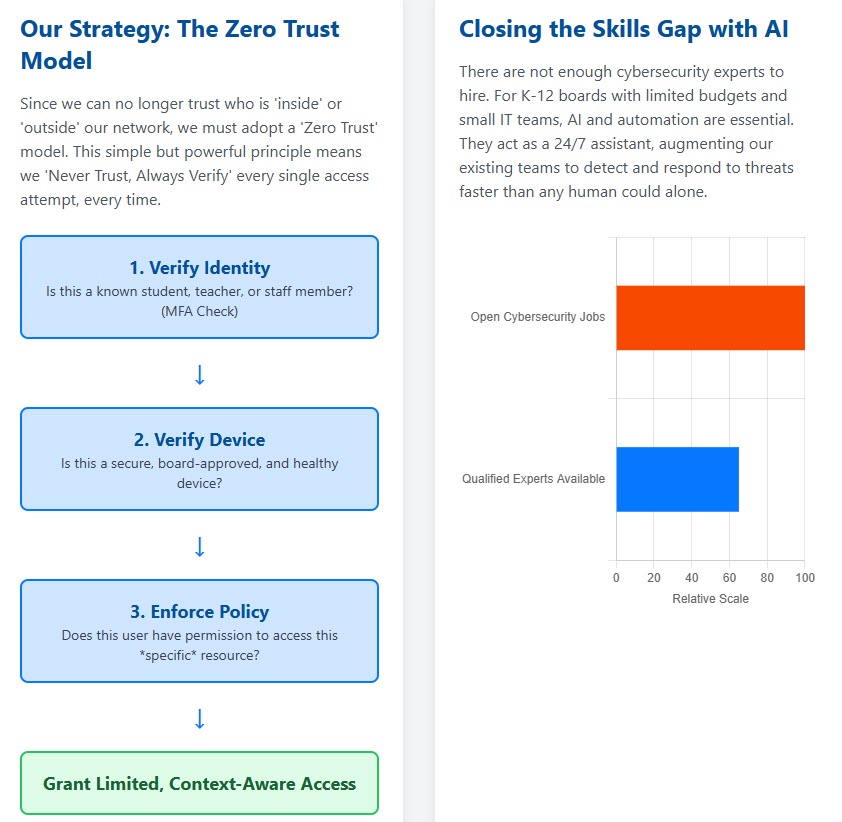
The K-12 sector is famously described as “target rich, cyber poor”. Most boards lack the resources to compete for cybersecurity talent, a risk amplified by a skills shortage that 69% of education institutions say creates additional risk.
So, how can they fight back?
First, by fighting AI with AI. Google’s report forecasts the “Agentic SOC” (Security Operations Center), where AI agents “perform the heavy lifting” of data correlation, allowing human analysts to “scale human intuition”. For school boards with small IT teams, investing in AI-powered defensive tools is not a luxury; it’s a force multiplier and a cost-effective necessity.
Second, this must be recognized as a crisis of governance, not just technology. Cybersecurity is a core leadership responsibility. A “cyber-aware culture” must be championed from the top down. This means:
-
Mandating Third-Party Risk Management (TPRM): Security and privacy compliance must be embedded into all procurement and contracting. Leadership must accept that accountability cannot be outsourced to vendors.
-
Enforcing Cyber Hygiene: The non-negotiable basics must be funded and enforced, including multi-factor authentication (MFA) for all staff, strong password/passphrase policies, and regular, offline backups.
-
Investing in Continuous Training: Human error remains a key vulnerability. Boards must leverage free, high-quality resources from partners like the CCCS and Fortinet to ensure every staff member is part of the defense.
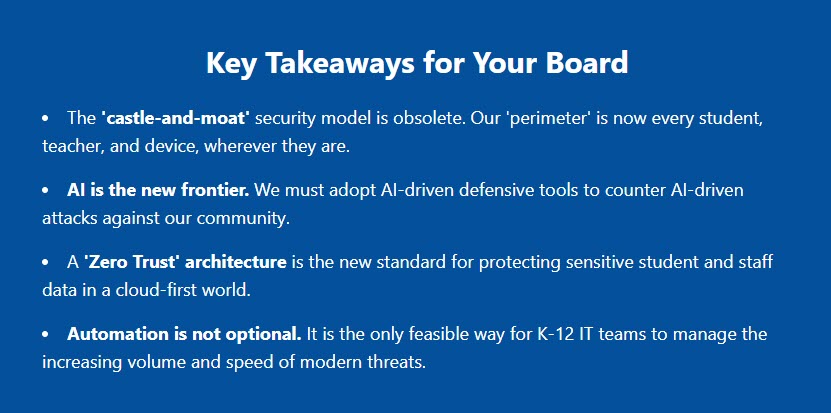
Google’s 2026 forecast is an invaluable tool, but not for predicting the future. It’s a call to action to deal with the present. The threats are automated, relentless, and already inside the gates. Building resilience is no longer just an IT project; it is the central governance challenge for Canadian education.
Originally published on Chris’s Musing on Substack.