
The Unwavering Call to Champions: Embracing Cybersecurity as a Shared Responsibility
As Canada commemorates Cyber Awareness Month, the conversation around digital security must evolve beyond a purely technical discussion. It is no longer a challenge confined to IT departments or government agencies; it is a collective imperative that requires a unified, national response. The foundational principle of this response is simple: cybersecurity is a shared responsibility, and every individual, organization, and institution has a crucial part to play. This concept gives rise to the “Cyber Champion”—an individual or entity who proactively works to protect, educate, and empower others to recognize and respond to threats.
The urgency of this mission has been explicitly acknowledged at the highest levels of government. The National Cyber Threat Assessment 2020 affirmed that “cyber security is one of the most serious economic and national security challenges we face.” The Minister of National Defence at the time, Harjit Sajjan, stressed that defending Canada and Canadians “is a shared responsibility and a team effort”. This sentiment is at the heart of the vision for Cyber Security. This framing suggests that the government’s strategic approach is not to centralize all security within a single agency, but rather to build a collaborative, distributed defence network. The government’s role, in this context, is to provide expert guidance and a strategic framework, while the daily vigilance and implementation of security measures rest with all Canadians. This approach makes the call to become a Cyber Champion a direct alignment with Canada’s official national policy.
The Evolving Threat Landscape: The Cost of Complacency
The need for a collective defence is underscored by the escalating cost and sophistication of cyber threats in Canada. The financial toll on both individuals and organizations is staggering and growing rapidly. In 2024, victims of fraud and cybercrime in Canada lost over $638 million, an increase from the $578 million lost in the previous year. The problem is pervasive across all sectors, with over 85% of Canadian companies affected by successful cyberattacks in one year. These attacks carry a significant financial burden. The average cost of a data breach for a Canadian organization is $6.32 million. For organizations in the financial sector, this figure rises even higher, reaching an average of $9.28 million per breach. The total spending on recovery from cybersecurity incidents in Canada doubled from $600 million in 2021 to a substantial $1.2 billion in 2023, illustrating the rapidly increasing financial repercussions of these incidents.
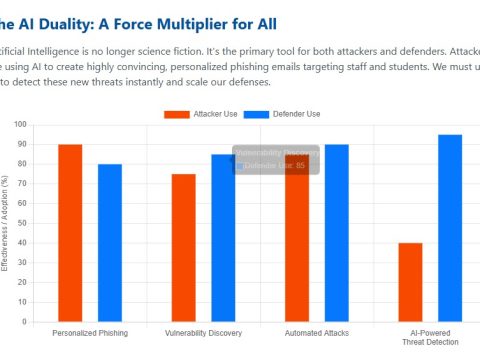
The primary entry points for these attacks are not complex, cutting-edge exploits but rather common and easily preventable vulnerabilities. Phishing and stolen credentials were identified as the top attack vectors in 2024, with an estimated 91% of all cyberattacks beginning with fraudulent emails. The proliferation of “cybercrime-as-a-service” and the commercial sale of cyber tools have made these attacks accessible to a wider pool of actors, making every business, regardless of its size or sector, a potential target. Recent high-profile incidents in Canada serve as stark reminders of this reality. A ransomware attack successfully halted production at the New Brunswick-based chocolate manufacturer (The Latest Cyberattacks in Canada) in early 2025 7, while another cyberattack disrupted IT systems across multiple schools in the Pembina Trails School Division. The vulnerability of third-party vendors was highlighted by the 2022 Toronto Symphony Orchestra Ransomware attack, whose patron information was compromised after its email provider was hit with a ransomware attack. These cases underscore that an organization is only as strong as its weakest business partner, a crucial insight that necessitates a collaborative approach to security.
Financial and Non-Financial Impacts of Cybercrime in Canada
The financial costs, while staggering, represent only a fraction of the total damage. The non-financial impacts of cybercrime, often hidden and far-reaching, include severe emotional and psychological harm. A 2024 RCMP Gazette article detailed the “deep impacts” of sophisticated scams, noting that victims can experience feelings of betrayal, anger, and sadness. The effects can be devastating, with identity fraud affecting every aspect of a victim’s life, from their mortgage to their ability to get a new car. The prevalence of victim-shaming, where individuals are met with comments like, “You should have known better,” can cause victims to feel embarrassed and ashamed, further discouraging them from reporting the crime. This creates a significant “dark figure” of crime, as only an estimated 5-10% of incidents are reported to authorities. The true scale of the cyber threat, therefore, is far greater than official statistics suggest, making the need for widespread awareness and proactive measures more critical than ever.
Pillar I: Protect – Building the Digital Fortress
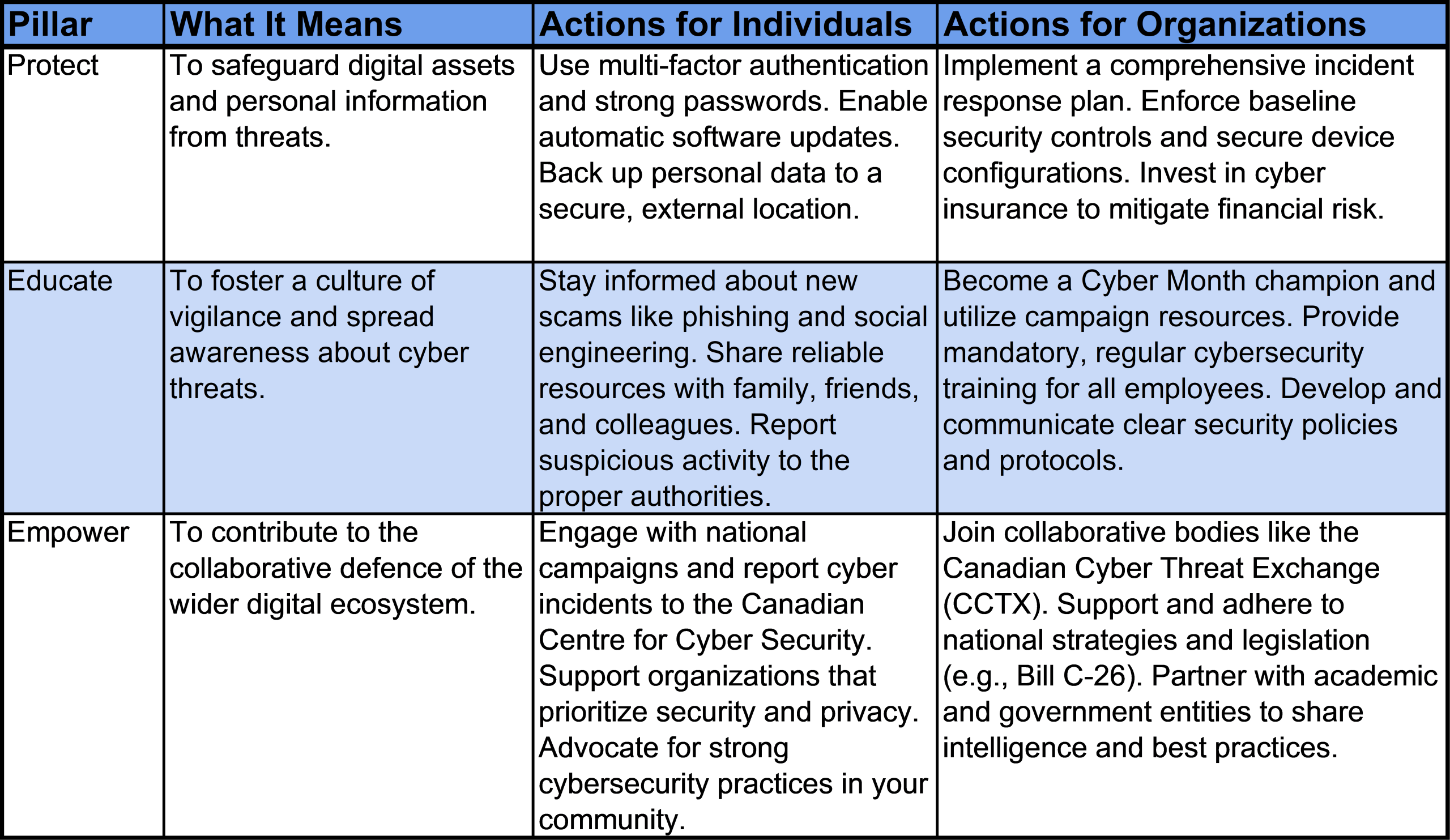
The first principle of a Cyber Champion is to protect oneself and their organization by building a robust digital fortress. This effort begins with foundational security hygiene, the disciplined adherence to basic practices that can prevent the vast majority of successful cyberattacks. Evidence from the Government of Canada’s Baseline cyber security controls for small and medium organizations indicates that many attacks succeed because of a failure to implement these fundamental measures.
For individuals, protection begins with simple, effective steps. It is imperative to enable multi-factor authentication (MFA) on all accounts, as it provides an essential second layer of defence.11 Passwords should be strong and unique for each account, and individuals should be vigilant in recognizing and avoiding the “7 red flags of phishing“. Devices and software should be kept secure by enabling automatic updates, while home connections should be protected with strong passwords and secure configurations.
For small and medium businesses (SMBs), which are often more vulnerable due to a lack of dedicated IT personnel, the Centre’s advice for SMBs focuses on foundational, high-impact security controls. Key recommendations include developing a basic written incident response plan , which outlines steps for detection, response, and recovery. Robust data backup and encryption strategies are also essential to ensure a business can continue operations after an incident. Furthermore, SMBs are advised to enforce strong user authentication, securely configure devices by changing default passwords, and manage access to information based on the principle of least privilege. Investing in a cybersecurity insurance policy is also a critical risk mitigation strategy, with 84% of Canadian companies having such policies. This insurance can help manage financial losses related to business interruption, investigation costs, and cyber extortion, demonstrating that a comprehensive protection strategy is as much about resilience and recovery as it is about prevention.
Pillar II: Educate – Fostering an Informed Society
The second pillar of a Cyber Champion’s creed is to educate others, transforming security from an individual burden into a shared social contract. This begins with broad public awareness campaigns and extends into targeted workforce training. The Government of Canada leads this effort with the Get Cyber Safe campaign, a national public awareness initiative designed to inform Canadians about the simple steps they can take to protect themselves online.
A major component of the campaign is Cyber Security Month in Canada each October, for which Get Cyber Safe serves as the Canadian lead. Organizations are encouraged to become “Cyber Month champions,” a role described as “key to the success” of the campaign. By participating and using the campaign’s resources, companies can raise awareness among their employees and audience, effectively decentralizing the educational effort and making it more scalable. This multi-level approach creates a dynamic partnership where the government provides the core message, and organizations act as force multipliers, localizing the content for their specific communities.
Beyond public awareness, the importance of training the workforce cannot be overstated. Employee training is considered “critical” because an astounding 95% of successful cyberattacks involve human error. Industry-led initiatives, such as the CFIB’s Your small business path to Cybersecurity, provide a model for effective education. The academy offers a comprehensive curriculum with courses on recognizing fraud, understanding phishing, and developing a robust incident response plan. This multi-stakeholder ecosystem of government-led campaigns, industry-specific training, and academic research creates a self-sustaining educational loop. Ontario Tech Business & IT, also contribute significantly by conducting multi-disciplinary research and providing services such as Cybersecurity Research to organizations. This synergy is a powerful demonstration of how education is a shared responsibility, with each component strengthening the others to build a more cyber-resilient society.
Pillar III: Empower – Forging a Collaborative Ecosystem
The final and most advanced pillar of a Cyber Champion’s mission is to empower others by forging a collaborative ecosystem that strengthens systemic defence. This involves participation in and support for national strategies, legislative frameworks, and public-private partnerships. Public Safety Canada first announced in 2018 with a $507.7 million investment, serves as Canada’s long-term plan to secure its digital future. A mid-term review of the strategy determined that while its goals remained appropriate, a “much-changed global context and growing threat landscape require a stronger federal response”.
This conclusion led directly to the introduction of the National Cyber Security Strategy, a key legislative response aimed at protecting Canadians and bolstering cybersecurity in federally regulated sectors such as finance, telecommunications, energy, and transportation.2 The Bill introduces the
Critical Cyber Systems Protection Act, which would establish a new regulatory framework to strengthen baseline security for systems “vital to national security and public safety”.2 This signifies a crucial evolution in government policy, shifting from a primarily advisory role to one that establishes mandatory baselines for critical infrastructure. This change is driven, in part, by the recognition that an organization’s vulnerability is often a function of its supply chain, a risk that requires systemic, not just individual, solutions.
This principle of collaboration is best exemplified by the work of the Canadian Cyber Threat Exchange (CCTX). The CCTX is described as Canada’s established leader in cross-sector collaboration, a platform where experts from public and private organizations work together on critical cybersecurity issues. Its strength lies in its diverse cross-sector membership, which includes companies of all sizes and from various industries. The CCTX gathers, enriches, analyzes, and shares actionable cyber threat intelligence with a Canadian focus, providing members with real-time threat feeds and intelligence reports. This allows for a unified network that strengthens the security posture of individual companies and enhances Canada’s overall resilience. Government bodies, like the Canadian Centre for Cyber Security, also empower Canadians by serving as the single unified source of expert advice and support, while the Canadian Anti-Fraud Centre works with law enforcement to gather intelligence on fraud and assist police with prevention.
Conclusion: A Unified Front for a Secure Future
The call to become a Cyber Champion is not an appeal to a select few; it is a summons to all. The data and analysis presented in this report demonstrate that a purely siloed, individualistic approach to cybersecurity is insufficient to meet the challenges of an increasingly sophisticated threat landscape. Canada’s digital resilience is inextricably linked to the collective actions of its citizens and organizations.
The three pillars—Protect, Educate, and Empower—form a cohesive, multi-layered defence system. When individuals and businesses commit to protect their digital assets with strong security hygiene, they build a resilient foundation from the ground up. By embracing the call to educate, they act as force multipliers, raising the collective awareness of their communities and workforces. And by actively participating in initiatives that empower the broader ecosystem, they contribute to the systemic changes necessary to secure the nation’s critical infrastructure.
Ultimately, the future of Canada’s digital security depends on the widespread adoption of this champion mindset. It requires a shift from passive concern to proactive engagement, and from isolated action to unified collaboration. In the face of a shared threat, the most effective response is a shared responsibility, a principle that, when put into practice, will ensure a more secure and prosperous future for all Canadians.
The Three Pillars of a Cyber Champion
Originally published on Chris’s Musing on Substack.